



Home / Outlets / Outlet Replacement
Outlet Replacement
Protection type is decided by location, which is what the code is really specifying. Dedicated circuits exist because some appliances do not share well, and a kitchen proves that faster than anywhere else.
Outlet Replacement in O’Fallon and across St. Charles, St. Louis, Lincoln and Warren counties.
Clint Ehman does the work himself. Seventeen years in the trade, Infinity Electric since June 2022.
5.0 from 94 Google reviews · BBB A+ since 2022
What this work actually involves
Protection is matched to the location, which is what the code is actually asking for when it calls out a GFCI.
First the reading, then the explanation, then the repair scoped to what was actually found. If that turns out smaller than the job you called about, that is what you are charged for.
Work needing a permit gets one and work needing an inspection is left ready for it. There is no handoff between whoever quotes and whoever fixes, because they are the same person.
When people call about this
- A tripping kitchen circuit
- Extension cords as permanent wiring
- Outlets with no ground
- A new appliance with no circuit
Why people choose Clint for it
A one-person shop cannot be in two places at once, so you get a real date instead of a window. What you also get is the same person every time.
Seventeen years in the trade, four of them on his own, 5.0 from 94 Google reviews and an A+ BBB accreditation since 2022.
Where this is done
Thirty towns across five jurisdictions, worked out of O’Fallon. The housing stock and the inspection process both change as you move across them.
See the full service area, or the rest of our outlets & circuits work.
Box fill, and why tidy work still fails
Every box has a volume, and every conductor, device and clamp inside it counts against that volume. Overfilled boxes are the commonest reason competent-looking work fails inspection.
It matters beyond the paperwork: crowded conductors are harder to terminate well and run hotter, and that is where failures begin.
Dedicated circuits and why they exist
Some appliances do not share. A microwave, a disposal, a dishwasher and a refrigerator each expect their own circuit, and a kitchen wired to an older standard usually has fewer circuits than the appliances now in it.
That is why a kitchen breaker trips when the microwave and the kettle run together. It is not a fault; it is arithmetic, and a dedicated circuit ends it.
Outlets, box fill and backstabbing
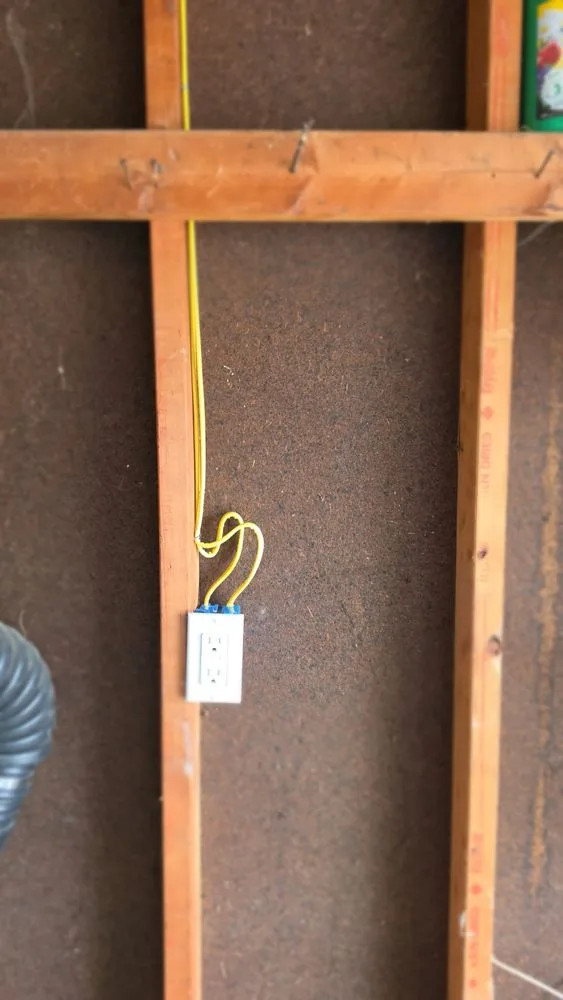
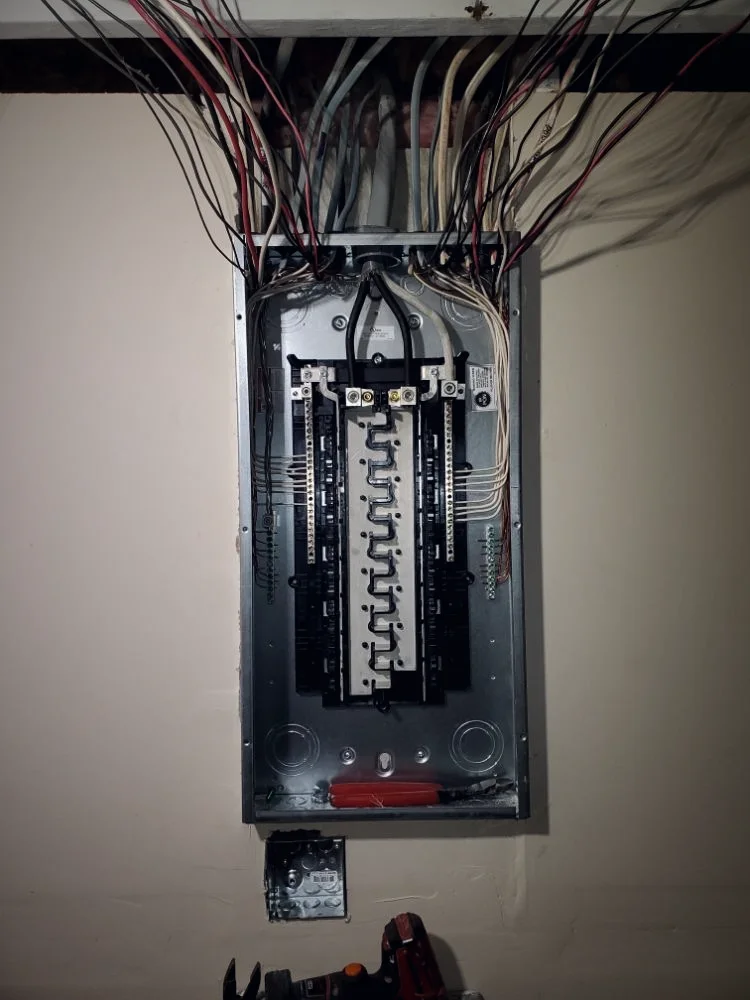
Two failures account for most outlet calls. Backstabbed conductors, pushed into the spring holes rather than under the screws, loosen and arc. And boxes stuffed past their fill rating overheat.
Devices go in with conductors under the screw terminals, box fill is checked against the conductor count, and protection is matched to the location rather than copied from the neighbour.
Spacing, protection and what the code is protecting against
Receptacle spacing rules exist so that nothing has to be run on an extension cord, and the wet-location protection rules exist because water and ground are the path through a person.
Both are cheap to satisfy during any work in the room and expensive to retrofit afterwards.
What makes this harder in older housing stock
Across this metro the recurring complications are predictable: no equipment ground, aluminum branch wiring from the mid-seventies, knob-and-tube buried in blown-in insulation, panels that have been added to several times, and splices in places the code has not allowed for decades.
Those turn a simple job into a decision about scope. The decision gets put to you with the reading behind it rather than made quietly and billed.
“Clint came out installed me a large 200 amp panel put some new dedicated lines in my basement and garage he did great clean work all inspections passed he was thorough and knowledgeable. I will have him back out again.”
Jason Holtzman · Google review
How the visit goes
- The call
What tripped, or what you want to plug in that there is nowhere to plug in.
- The measurement
Tracing the circuit to find everything already on it, then checking box fill, gauge and existing protection.
- The finding
Whether this is a new dedicated circuit or a device swap, and whether protection needs upgrading for the location.
- The work
Circuit run and terminated properly, devices installed tight rather than backstabbed, protection matched to location, and every outlet on the circuit tested.
What the job includes
- Tracing the existing circuit before anything is added
- Correct protection for the location, GFCI or AFCI as the code calls for
- Dedicated circuits where an appliance needs one
- Box fill and wire gauge checked and corrected
- Devices installed level and tight, not backstabbed
- Testing at every outlet on the circuit
What it does not
- Appliance installation beyond the connection
- Cabinet or countertop modification
- Low-voltage data unless it is part of the same job
Work that is not electrical gets a referral, not a quote. Finished work is in the gallery. To book, pick a day.
Related outlets & circuits work
Outlet Replacement across the metro
Where the house is changes what the work involves. What an inspector looks at first differs by address here, which shapes the job as much as the house does.
St. Louis County
The obsolete panel brands concentrate in this county, because they were installed through exactly the decades this housing was built and upgraded.
St. Louis City
The City is an independent city, not part of the County, and it runs its own permits and inspections. Assuming county process here is a common and expensive mistake.
Lincoln County
Outages last longer this far from town, which changes the backup conversation from comfort to the pump.
Every municipality covered is listed on the service areas page.
Questions worth asking first.
Why does my kitchen breaker keep tripping?
Usually too much on one circuit rather than a fault. Tracing the circuit shows what is sharing it, and a dedicated circuit for the heavy appliance normally ends it.
Do I need GFCI everywhere?
Where the code calls for it: kitchens, baths, garages, outdoors and unfinished basements. It is the cheapest safety work in a house and the easiest to add.
Why is my outlet warm?
Heat at a device means a loose or backstabbed termination arcing, and it does not resolve itself. That one gets looked at promptly rather than scheduled out.
Are you licensed and insured?
Licensed, bonded and insured, with workers compensation coverage, and accredited A+ with the BBB since 2022.
Where do you work?
Out of O’Fallon across St. Charles County, St. Louis County, St. Louis City, and Lincoln and Warren counties, roughly a fifty mile radius.
Find out which problem you have.
Several causes, very different prices, and only a measurement separates them. Outlet Replacement in O’Fallon and across the metro.
Weekdays 8-5, Fri to 4, Sat 10-3 · or describe it in writing.