

Home / Generators / Generator Interlock Installation
Generator Interlock Installation
Backup power is bought for one week a year and judged on that week. Surge protection is the cheapest insurance in the house, and whole-home protection works differently from a power strip.
Generator Interlock Installation in O’Fallon and across St. Charles, St. Louis, Lincoln and Warren counties.
Owner-operated: the person who answers the phone is the person who measures it.
5.0 from 94 Google reviews · BBB A+ since 2022
What this work actually involves
Surge protection is installed at the panel where it can clamp what comes in, not just at the device.
Clint measures before he quotes. The reading comes first, then what it means, then the one repair that solves it. If the honest answer is smaller than what you called about, that is the answer you get, even when the bigger job pays better.
Work that needs a permit gets one, and work that needs an inspection is left ready for it. One person does the diagnosis and the repair, so nothing is lost between a salesman and a technician.
When people call about this
- A sump pump and a finished basement
- Portable generator cords through a window
- A home office that cannot go dark
- Electronics lost to a storm
Why people choose Clint for it
The diagnosis and the repair are the same person’s work, which is why the explanation you get is first-hand rather than relayed.
Five point zero from 94 Google reviews, A+ with the BBB since December 2022, and seventeen years in the trade behind it.
Where this is done
A roughly fifty mile working radius from O’Fallon, covering thirty municipalities across five jurisdictions in the St. Louis metro.
See the full service area, or the rest of our backup power work.
Surge protection that actually works
Whole-home surge protection installs at the panel, where it can clamp what arrives on the service conductors. A power strip protects one device from what is already inside the house.
Both have a place. Layered protection, panel plus point-of-use for sensitive electronics, is what survives a Missouri storm season intact.
Deciding what stays on
The design work in backup power is choosing loads. A furnace blower, a well pump, a sump pump, the refrigerator and a few lighting circuits keep a house functioning through an outage and need far less generator than running everything.
Whole-house standby is available and costs accordingly. Picking loads deliberately is usually the difference between a system that gets installed and one that stays a quote.
Sizing it to what you actually need running
The cost difference between keeping the essentials alive and running the whole house is large, and it is decided by a list you write: furnace blower, refrigerator, well pump, sump, a few circuits of light. Added up honestly, that list is usually smaller than people expect.
Whatever the size, the transfer has to make back-feeding physically impossible, which is a transfer switch or a listed interlock, never a cord into a dryer outlet. That is the part inspectors look at and the part that protects the utility crews working the line.
Permits, inspections and why they vary here
Requirements genuinely differ across this metro. O’Fallon, St. Charles, St. Peters, the St. Louis County municipalities and St. Louis City each run their own process, and what one treats as a minor repair another permits and inspects.
Work that needs a permit gets one, and work that needs an inspection is left ready for it with the panel labeled and the junctions accessible. That matters most before a closing, when an inspector’s written item becomes someone’s negotiating position.
What gets left behind when the work is done
A labeled panel, accessible junctions, the old parts if you want to see them, and a straight account of anything found along the way that was not part of the call.
Where something else was found, you get told what it is and whether it needs doing now, later or not at all. That third answer is a real answer and it gets used.
“Clint did an excellent job installing two bathroom exhaust fans. He installed high-quality fans that were far superior to the ones I had purchased from a big box store. I highly recommend his services.”
David Hinners · Google review
How the visit goes
- The call
What you need to keep running and how often the power goes out where you are.
- The measurement
The loads you named, added up honestly, and the panel’s capacity to feed a transfer switch or interlock.
- The finding
A size and a configuration, with the cost difference between keeping the essentials on and running the whole house made plain.
- The work
Unit sited, circuit run, transfer switch or interlock installed so back-feeding is impossible, inspected, then a walkthrough of starting and transferring with you present.
What the job includes
- Load selection: what has to run, what can wait
- Generator or inlet sized to the chosen loads
- Transfer switch or interlock so back-feeding is impossible
- Pad or mounting, and the circuit to it
- Permit and inspection where required
- A walkthrough of starting and transferring, in person
What it does not
- Gas piping, which is the plumber’s trade
- Concrete pads beyond a prefabricated base
- Generator servicing contracts
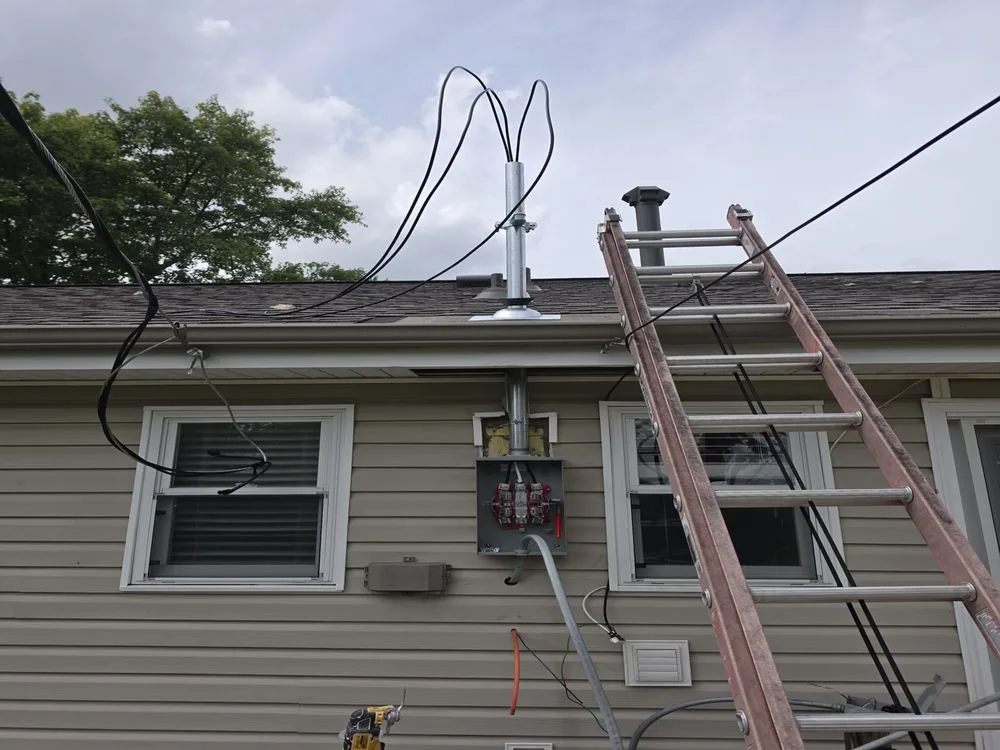
Anything that is not an electrical problem gets identified as such and handed on. Finished work is in the gallery. To book, pick a day.
Related backup power work
Generator Interlock Installation across the metro
Five jurisdictions, five different sets of conditions. What an inspector looks at first differs by address here, which shapes the job as much as the house does.
St. Louis City
Fishing a wall is harder here and sometimes not possible, so the honest answer about opening one comes before the work rather than during it.
Lincoln County
Distance is the design factor out here. A run to a shop or a well house is often hundreds of feet, which makes voltage drop a real calculation rather than a textbook one.
Warren County
Warren County mixes newer builds with older farm properties, and generator work comes up more often there than it does in town.
County by county coverage is on the service areas page.
Questions worth asking first.
Can I use a generator cord into a dryer outlet?
No. That back-feeds the utility and endangers the crews working your line. A transfer switch or a listed interlock is what makes that physically impossible.
Battery or generator?
A battery is silent and instant for a limited number of hours; a generator runs as long as it has fuel. How long your power usually stays out decides it.
What size generator do I need?
It depends on what has to keep running. A well pump, a sump pump and a furnace need very different capacity from a whole house, and picking the loads deliberately keeps the cost sensible.
Do you pull permits?
Where the municipality requires one, yes, and the work is left ready for inspection with the panel labeled and junctions accessible. Requirements genuinely differ across this metro, which is why it is established per address rather than assumed.
How long have you been doing this?
Clint has seventeen years in the trade and has been running his own shop out of O’Fallon since 2022.
Ask what it actually reads.
You get the figure and what it means, before any work is agreed. Generator Interlock Installation in O’Fallon and across the metro.
Mon-Thu 8-5 · Fri 8-4 · Sat 10-3. A written note works too.