




Home / Rewiring / Electrical Repair for Older Homes
Electrical Repair for Older Homes
What gets left in the wall matters as much as what comes out. Aluminum branch wiring is a termination problem, not a wire problem, and the accepted remedy is far smaller than a full rewire.
Electrical Repair for Older Homes in O’Fallon and across St. Charles, St. Louis, Lincoln and Warren counties.
One electrician, start to finish. Seventeen years in the trade and four running his own shop out of O’Fallon.
5.0 from 94 Google reviews · BBB A+ since 2022
What this work actually involves
Grounding is brought up to current requirements, which is usually what makes the difference for a buyer’s inspector.
The measurement happens before the number. You hear what the reading says in plain words, then what it means, then what it will take to fix. Where the fix is small you are told that rather than sold past it.
Permits get pulled where the municipality asks for one, and the work is left ready for the inspector with the panel labeled. The same person does the diagnosis and the repair.
When people call about this
- Circuits that dim when anything starts
- Two-prong outlets throughout
- Cloth or rubber insulation at the panel
- Warm switch plates
Why people choose Clint for it
What the reviews keep mentioning is being told what the problem actually was. That is what an owner-operated shop can do and a dispatch model structurally cannot.
Seventeen years in the trade, 5.0 from 94 Google reviews, and BBB accredited A+ since December 2022.
Where this is done
O’Fallon first, then the rest of St. Charles County, St. Louis County and the City, and out to Lincoln and Warren. If you are just past that, the call is still worth making.
See the full service area, or the rest of our wiring & rewiring work.
How a rewire is staged
A rewire is disruptive, so it gets staged. Circuits are replaced zone by zone with the panel reworked once, which keeps the house livable and means the family is never without the kitchen and the bathroom at the same time.
Fishing walls beats opening them wherever the framing allows. Where drywall has to come out, it comes out in planned places rather than wherever is convenient.
What is actually wrong with old wiring
Knob-and-tube was installed competently for the loads of its day, and plenty of it tests sound. Its weaknesses are specific: no equipment ground, brittle insulation at fixtures where heat collected, and a serious problem if someone has buried it in blown-in insulation.
Aluminum branch wiring from the 1960s and 70s is different again. The conductor is fine; the terminations creep and loosen. The accepted remedy treats those connections, which is a far smaller job than a rewire.
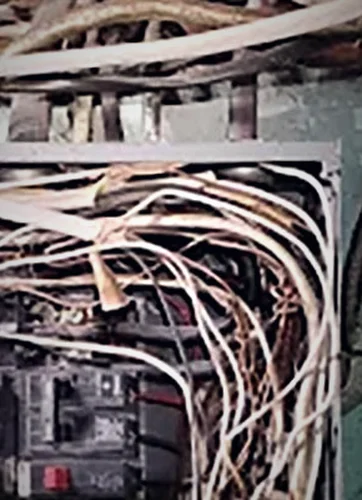
What older houses here actually have in them
The housing stock across this metro means a predictable set: fuse panels, aluminum branch wiring from the mid-seventies, knob-and-tube under blown-in insulation, two-prong outlets with no equipment ground, and panels added to several times.
None of those is automatically an emergency and none is automatically fine. They get tested, and you are told which category each one falls into before anything is quoted.
What gets left behind when the work is done
A labeled panel, accessible junctions, the old parts if you want to see them, and a straight account of anything found along the way that was not part of the call.
Where something else was found, you get told what it is and whether it needs doing now, later or not at all. That third answer is a real answer and it gets used.
What the price actually depends on
Three things move the number on almost every job: how far the run has to travel and what it passes through, whether the existing panel has space and the service has capacity, and whether the municipality wants a permit and an inspection. None of those is visible from the phone call, which is why the measurement comes before the quote.
What does not move it is urgency theatre. There is no inflated figure waiting to be discounted, and no bundle built so the thing you called about cannot be bought on its own.
“Clint did an excellent job installing two bathroom exhaust fans. He installed high-quality fans that were far superior to the ones I had purchased from a big box store. I highly recommend his services.”
David Hinners · Google review
How the visit goes
- The call
What is in the walls, how old the house is, and whether this is for safety, a sale or a remodel. The reason changes the scope.
- The measurement
Testing at accessible terminations and devices, checking for an equipment ground, and looking for the specific hazards: buried knob-and-tube, brittle insulation at fixtures, creeping aluminum connections.
- The finding
Honest scope. Wire that tests sound stays. Where a rewire is the answer it is staged, and you are told what order and how long the house is affected.
- The work
Zone by zone, fishing walls rather than opening them where the framing allows, grounding brought current, rough-in photographed before anything closes up.
What the job includes
- Inspection of every accessible termination, which is where failures live
- Testing before anything is removed, so sound wire stays in the wall
- Staged replacement room by room where a rewire is the honest answer
- Grounding brought to current requirements
- Permit and inspection where required
- Photographs of the rough-in before anything closes up
What it does not
- Plaster and drywall finishing beyond patching access holes
- Insulation replacement
- Removing wire that is safe to leave in place
Work that is not electrical gets a referral, not a quote. Recent jobs are worth a look before you call.
Related wiring & rewiring work
Electrical Repair for Older Homes across the metro
Housing stock varies sharply across the counties here, and so does the work. Out of O’Fallon across thirty municipalities, where the permit process changes more than the work does.
St. Charles County
The subdivisions here were wired correctly for what houses drew at the time. A charger, a heat pump and a finished lower level later, the arithmetic no longer works out.
St. Louis County
Houses with real history in the walls, and a permit process that changes from one municipality to the next.
St. Louis City
The City is an independent city, not part of the County, and it runs its own permits and inspections. Assuming county process here is a common and expensive mistake.
The full footprint, county by county, is on the service areas page.
Questions worth asking first.
Can a rewire be done in stages?
Yes, zone by zone with the house powered throughout and each stage inspected before the next. That is usually how an occupied house is done.
Does old wiring mean the whole house has to be rewired?
Almost never. Aluminum branch wiring is a termination problem with an accepted remedy. Knob-and-tube that tests sound and is not buried in insulation can often stay. The measurement decides it, not the age.
Will an inspector pass it?
That depends on grounding and terminations more than on the conductors. Those are the items that get corrected, documented and re-inspected so a file closes.
Where do you work?
Out of O’Fallon across St. Charles County, St. Louis County, St. Louis City, and Lincoln and Warren counties, roughly a fifty mile radius.
Do you pull permits?
Where the municipality requires one, yes, and the work is left ready for inspection with the panel labeled and junctions accessible. Requirements genuinely differ across this metro, which is why it is established per address rather than assumed.
Describe the symptom, not the diagnosis.
That is usually enough to say what the visit involves before anyone is booked. Electrical Repair for Older Homes in O’Fallon and across the metro.
Reachable Mon-Thu 8-5, Fri 8-4, Sat 10-3. Outside those hours, leave the details.