



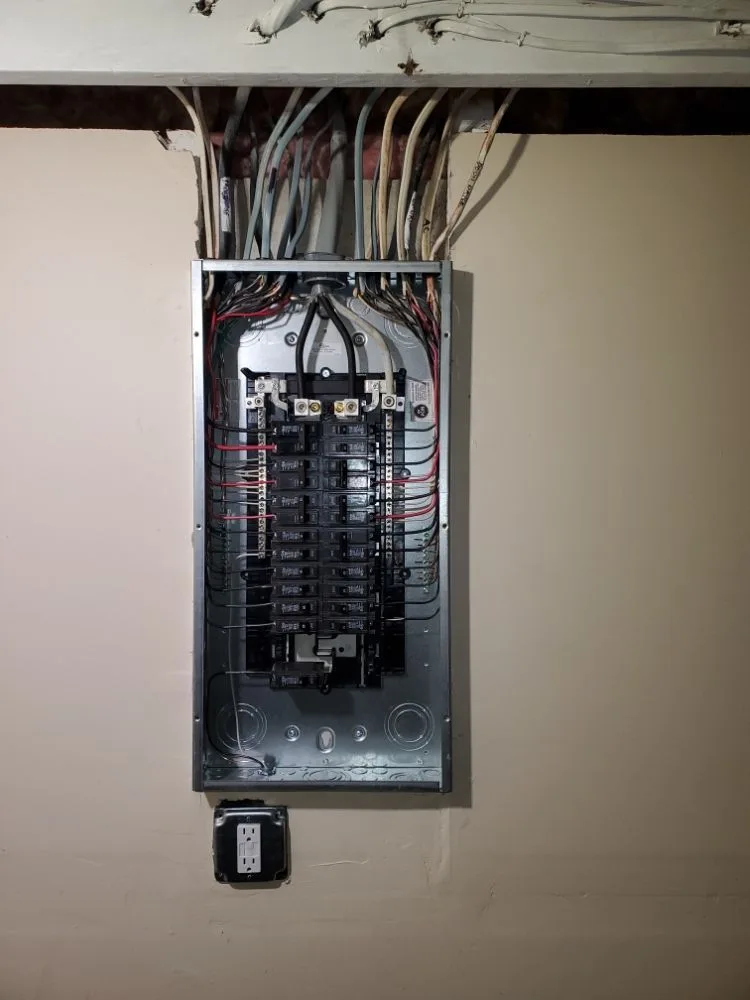
Home / Panels / Electrical Meter Base Replacement
Electrical Meter Base Replacement
Service equipment ages differently from the wire it feeds, which is why the two get judged separately. A service either carries what the house asks of it or it does not, and a load calculation answers that in numbers rather than opinions.
Electrical Meter Base Replacement in O’Fallon and across St. Charles, St. Louis, Lincoln and Warren counties.
Owner-operated: the person who answers the phone is the person who measures it.
5.0 from 94 Google reviews · BBB A+ since 2022
What this work actually involves
Permits are pulled where the municipality requires them, and the work is left ready for inspection rather than tidied up afterward.
Nothing gets quoted off a description. The reading comes first, because a symptom has several possible causes at very different prices and only a measurement separates them.
Where a permit and an inspection are required they happen, and the site is left ready for them. One person carries the job from the first call to the final test.
When people call about this
- Lights that dim when a large appliance starts
- Breakers that trip under normal load
- A panel brand an inspector flags on sight
- Scorch marks, heat or a smell at the cover
Why people choose Clint for it
A one-person shop cannot be in two places at once, so you get a real date instead of a window. What you also get is the same person every time.
Seventeen years in the trade, four of them on his own, 5.0 from 94 Google reviews and an A+ BBB accreditation since 2022.
Where this is done
Out of O’Fallon across five jurisdictions: St. Charles County, St. Louis County, St. Louis City, and Lincoln and Warren counties. About fifty miles in any direction.
See the full service area, or the rest of our panels & service work.
What a panel directory is worth later
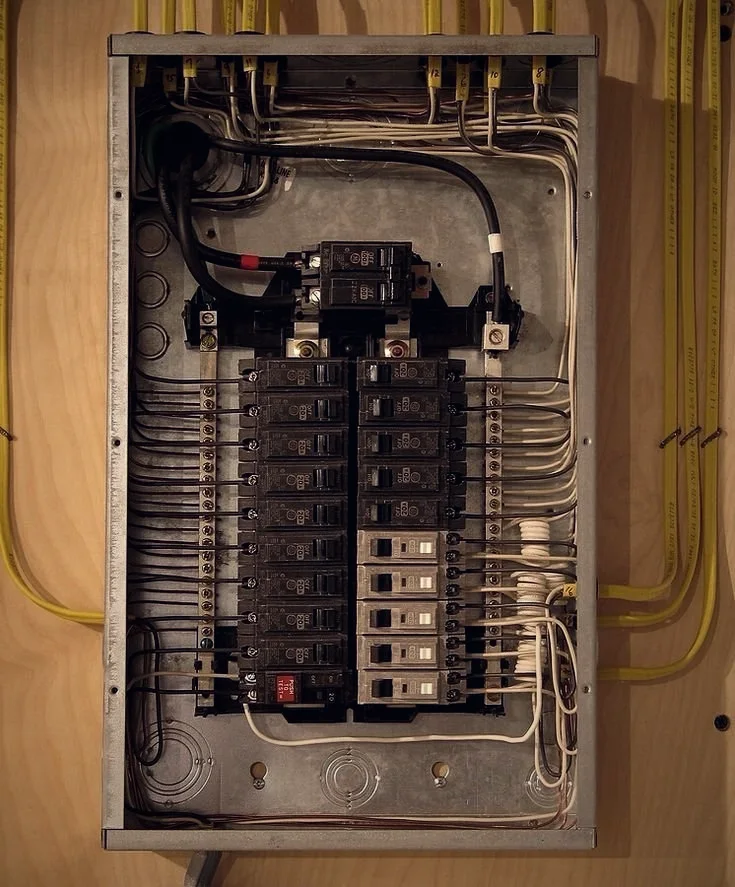
An accurate circuit directory is the cheapest thing in a panel and the one most often missing. Without it, every future visit starts with twenty minutes of somebody switching breakers off and shouting down a hallway, and you pay for those twenty minutes.
Every circuit gets identified and written on the directory as part of the work. It is also one of the first things a municipal inspector looks at, because an unlabeled panel is a hazard to whoever opens it next.
What the utility controls and what you do
Everything from the transformer to the meter belongs to Ameren. The meter base, the service entrance conductors, the mast and everything inside belong to the house. The split matters because it decides who pays and who schedules.
Work crossing that line needs a utility disconnect on a scheduled day, which is the single biggest factor in how long a panel job takes. That date gets established before the work is booked, not discovered on the morning.
The meter base is the utility’s side of the wall
The meter base and the service entrance are where the utility’s conductors become the house’s, and they take the weather directly. Rust at the base, a cracked hub, or a pulled-away weatherhead lets water into the enclosure and down the conductors.
Replacing it means coordinating the disconnect with Ameren, so the work happens on a scheduled day rather than whenever. The permit and the inspection go with it, and the house is back on the same day.
What a tripping main actually means
A branch breaker trips to protect its circuit. The main trips to protect the service, which means the whole house asked for more than the service carries at that moment. Those are completely different findings.
A main that trips is a capacity conversation and it needs the load measured under real conditions rather than guessed at. It is also the one symptom where the answer genuinely is sometimes a service upgrade.
Why two panels of the same age differ
Two houses built the same year can have panels in completely different condition, because what matters is what has been done to them since. A panel that has been added to carefully is sound at thirty years. One that has had tandem breakers forced into a bus not rated for them is not sound at fifteen.
So age is a weak signal and the cover being off is a strong one. What gets looked at is the bus, the lugs, the breaker fit and the grounding, and those four tell you more than the date on the label.
“Clint came out installed me a large 200 amp panel put some new dedicated lines in my basement and garage he did great clean work all inspections passed he was thorough and knowledgeable. I will have him back out again.”
Jason Holtzman · Google review
How the visit goes
- The call
You describe what the house is doing and what prompted it: a tripping breaker, an inspector’s note, a planned addition. That shapes what gets measured first.
- The measurement
Load across the service under real conditions, voltage at the main, the condition of every lug and the bus. On an older panel, the breaker brand gets identified, because some have no listed replacement still made.
- The finding
You get the number and what it means. If the service carries what the house asks of it, you hear that, and the conversation becomes a sub-panel or a single circuit instead of a service upgrade.
- The work
Permit where required, utility coordinated for the disconnect, new equipment installed, every circuit identified and labeled, and the site left ready for the inspector.
What the job includes
- A load calculation against what the house actually runs, given to you as a number
- Permit application where the municipality requires one
- New panel, breakers and a legible circuit directory
- Utility coordination for the disconnect and reconnect
- Grounding and bonding brought to current requirements
- The site left ready for inspection, and the inspection attended
What it does not
- Drywall repair beyond the panel opening
- Appliance repair, which is a different trade
- Work on the utility side of the meter, which is the utility’s own
Plumbing, HVAC and structural work get a pointer to someone who does them properly. Finished work is in the gallery. To book, pick a day.
Related panels & service work
Electrical Meter Base Replacement across the metro
Five jurisdictions, five different sets of conditions. What an inspector looks at first differs by address here, which shapes the job as much as the house does.
St. Louis City
Brick with plaster over lath, party walls that limit where a run can go, and a hundred years of electrical layers in the basement.
Lincoln County
Rural properties where the panel is fine and the two hundred foot run to the barn is the actual job.
Warren County
Which of those you have changes the entire conversation, so the first visit establishes what is actually there rather than assuming from the address.
Thirty towns across five jurisdictions, all on the service areas page.
Questions worth asking first.
How do I know if my panel brand is a problem?
Federal Pacific Stab-Lok and Zinsco both have documented failure-to-trip histories and no current listed replacement breaker, so the panel gets replaced rather than repaired. The label on the door identifies it in seconds.
Do I need a permit for panel work?
In every municipality in this footprint, yes, plus an inspection and a scheduled utility disconnect. That is why a panel change is a planned day rather than a same-day call.
Do I need a bigger service, or just more space in the panel?
Those are different problems. A full panel with spare capacity takes a sub-panel or tandem breakers. A panel that is out of capacity takes a service upgrade, and the load calculation tells us which one you have before anything is ordered.
Where do you work?
Out of O’Fallon across St. Charles County, St. Louis County, St. Louis City, and Lincoln and Warren counties, roughly a fifty mile radius.
Do you pull permits?
Where the municipality requires one, yes, and the work is left ready for inspection with the panel labeled and junctions accessible. Requirements genuinely differ across this metro, which is why it is established per address rather than assumed.
Find out which problem you have.
Several causes, very different prices, and only a measurement separates them. Electrical Meter Base Replacement in O’Fallon and across the metro.
Mon-Thu 8-5 · Fri 8-4 · Sat 10-3. A written note works too.