




Home / Outlets / Electrical Outlet Repair
Electrical Outlet Repair
Switch and outlet work is where previous handyman jobs usually surface. GFCI and AFCI requirements changed for good reasons, and they are the cheapest safety work available in a house.
Electrical Outlet Repair in O’Fallon and across St. Charles, St. Louis, Lincoln and Warren counties.
One electrician, start to finish. Seventeen years in the trade and four running his own shop out of O’Fallon.
5.0 from 94 Google reviews · BBB A+ since 2022
What this work actually involves
Box fill and wire gauge get checked, because that is what fails inspection when a handyman has been there first.
The order is always the same: reproduce it, measure it, say what the number means, fix the thing the number points at. Nothing gets bundled on the way past.
Permits and inspections happen where the municipality requires them, and the panel is left labeled. One person does all of it.
When people call about this
- A tripping kitchen circuit
- Extension cords as permanent wiring
- Outlets with no ground
- A new appliance with no circuit
Why people choose Clint for it
What the reviews keep mentioning is being told what the problem actually was. That is what an owner-operated shop can do and a dispatch model structurally cannot.
Seventeen years in the trade, 5.0 from 94 Google reviews, and BBB accredited A+ since December 2022.
Where this is done
O’Fallon and the surrounding St. Charles County suburbs, out through St. Louis County and St. Louis City, and into Lincoln and Warren counties. Roughly a fifty mile radius.
See the full service area, or the rest of our outlets & circuits work.
GFCI, AFCI and what each is for
GFCI protects people: it watches for current leaving the circuit through something that is not the neutral, which is what an electric shock looks like electrically. It belongs where water is.
AFCI protects the building: it listens for the signature of an arc, which is what a loose connection or a damaged cable does before it starts a fire. Bedroom circuits call for it for that reason.
Box fill, and why tidy work still fails
Every box has a volume, and every conductor, device and clamp inside it counts against that volume. Overfilled boxes are the commonest reason competent-looking work fails inspection.
It matters beyond the paperwork: crowded conductors are harder to terminate well and run hotter, and that is where failures begin.
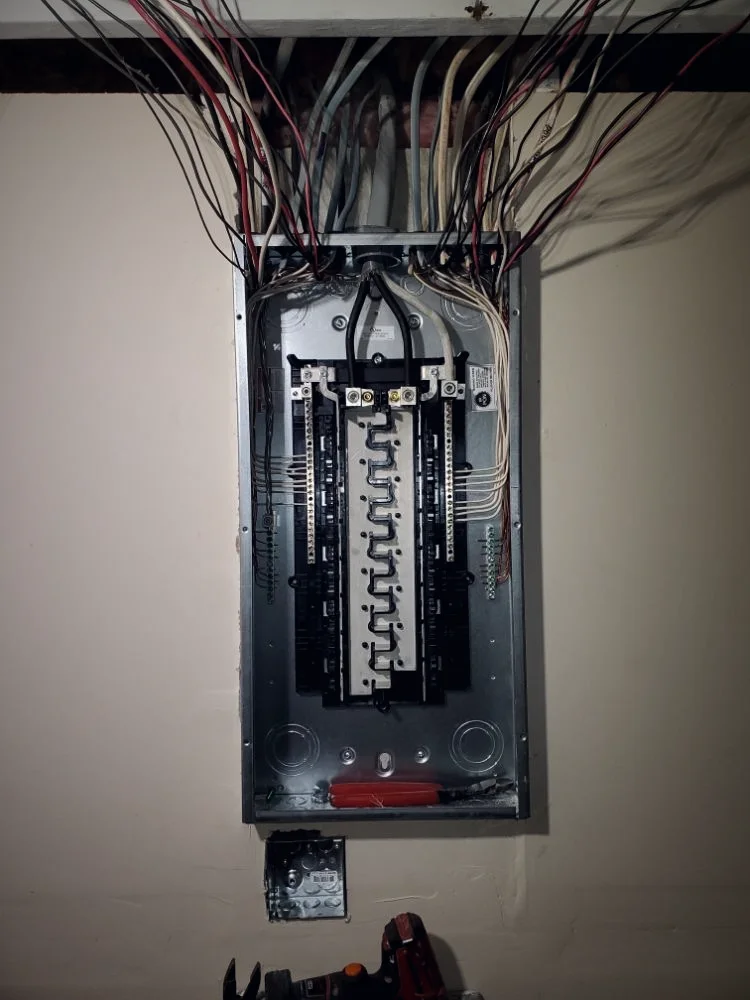
Outlets, box fill and backstabbing
Two failures account for most outlet calls. Backstabbed conductors, pushed into the spring holes rather than under the screws, loosen and arc. And boxes stuffed past their fill rating overheat.
Devices go in with conductors under the screw terminals, box fill is checked against the conductor count, and protection is matched to the location rather than copied from the neighbour.
What the price actually depends on
Three things move the number on almost every job: how far the run has to travel and what it passes through, whether the existing panel has space and the service has capacity, and whether the municipality wants a permit and an inspection. None of those is visible from the phone call, which is why the measurement comes before the quote.
What does not move it is urgency theatre. There is no inflated figure waiting to be discounted, and no bundle built so the thing you called about cannot be bought on its own.
What gets left behind when the work is done
A labeled panel, accessible junctions, the old parts if you want to see them, and a straight account of anything found along the way that was not part of the call.
Where something else was found, you get told what it is and whether it needs doing now, later or not at all. That third answer is a real answer and it gets used.
“Clint did an excellent job installing two bathroom exhaust fans. He installed high-quality fans that were far superior to the ones I had purchased from a big box store. I highly recommend his services.”
David Hinners · Google review
How the visit goes
- The call
What tripped, or what you want to plug in that there is nowhere to plug in.
- The measurement
Tracing the circuit to find everything already on it, then checking box fill, gauge and existing protection.
- The finding
Whether this is a new dedicated circuit or a device swap, and whether protection needs upgrading for the location.
- The work
Circuit run and terminated properly, devices installed tight rather than backstabbed, protection matched to location, and every outlet on the circuit tested.
What the job includes
- Tracing the existing circuit before anything is added
- Correct protection for the location, GFCI or AFCI as the code calls for
- Dedicated circuits where an appliance needs one
- Box fill and wire gauge checked and corrected
- Devices installed level and tight, not backstabbed
- Testing at every outlet on the circuit
Related outlets & circuits work
Electrical Outlet Repair across the metro
Housing stock varies sharply across the counties here, and so does the work. Out of O’Fallon across thirty municipalities, where the permit process changes more than the work does.
St. Louis City
Much of this stock is two and four family, which means shared services and panels that are rarely labeled accurately.
Lincoln County
Rural properties where the panel is fine and the two hundred foot run to the barn is the actual job.
Warren County
Backup power is a more common purchase out here, and when a well pump is the water supply the loads that matter are not the kitchen.
The whole working radius is mapped on the service areas page.
Questions worth asking first.
Can you add an outlet without opening the wall?
Usually, depending on framing, insulation and fire blocking in the cavity. You get a straight answer about which before the work starts.
Why does my kitchen breaker keep tripping?
Usually too much on one circuit rather than a fault. Tracing the circuit shows what is sharing it, and a dedicated circuit for the heavy appliance normally ends it.
Do I need GFCI everywhere?
Where the code calls for it: kitchens, baths, garages, outdoors and unfinished basements. It is the cheapest safety work in a house and the easiest to add.
Do you pull permits?
Where the municipality requires one, yes, and the work is left ready for inspection with the panel labeled and junctions accessible. Requirements genuinely differ across this metro, which is why it is established per address rather than assumed.
How long have you been doing this?
Clint has seventeen years in the trade and has been running his own shop out of O’Fallon since 2022.
Find out which problem you have.
Several causes, very different prices, and only a measurement separates them. Electrical Outlet Repair in O’Fallon and across the metro.
Mon-Thu 8-5 · Fri 8-4 · Sat 10-3. Prefer to write it down? Write it here.