



Home / Lighting / Landscape Lighting
Landscape Lighting
LED retrofits fail at the driver and the dimmer, almost never at the diode. Most lighting complaints are not about brightness. They are about where the light falls and what it does to the room.
Landscape Lighting in O’Fallon and across St. Charles, St. Louis, Lincoln and Warren counties.
One electrician, start to finish. Seventeen years in the trade and four running his own shop out of O’Fallon.
5.0 from 94 Google reviews · BBB A+ since 2022
What this work actually involves
Dimming is matched to the driver, because an LED on the wrong dimmer buzzes or flickers no matter how good the fixture is.
A number follows a measurement here, never a guess. You get told what the reading was and what it means before any work is agreed, including on the days when the answer is one loose connection.
Permitted and inspected where the address requires it, labeled at the panel, and done by the person who diagnosed it rather than handed down a chain.
When people call about this
- LEDs that flicker on a dimmer
- A remodel with no lighting plan
- Fixtures older than the wiring
- A kitchen lit by one center fixture
Why people choose Clint for it
What the reviews keep mentioning is being told what the problem actually was. That is what an owner-operated shop can do and a dispatch model structurally cannot.
Seventeen years in the trade, 5.0 from 94 Google reviews, and BBB accredited A+ since December 2022.
Where this is done
O’Fallon and the surrounding St. Charles County suburbs, out through St. Louis County and St. Louis City, and into Lincoln and Warren counties. Roughly a fifty mile radius.
See the full service area, or the rest of our lighting work.
Why the dimmer is half the install
A dimmer built for filament bulbs expects a load that an LED does not present, so the bottom of the range becomes flicker, buzz, or a dead zone. The lamps get blamed and replaced, and nothing improves.
Matching the dimmer to the specific fixtures, and checking the minimum load, is what makes an LED dim smoothly to the bottom. It gets tested on the circuit before the ladder comes down.
Dimming, drivers and flicker
LED flicker is a dimmer problem almost every time. An LED driver needs a dimmer rated for electronic low voltage or for LED loads, and a trailing-edge dimmer behaves very differently from the old incandescent one it replaced.
Minimum load matters too. Some dimmers need more wattage on the circuit than three LED cans provide, which is exactly when a brand new install buzzes.
Low-voltage outdoors, done to last
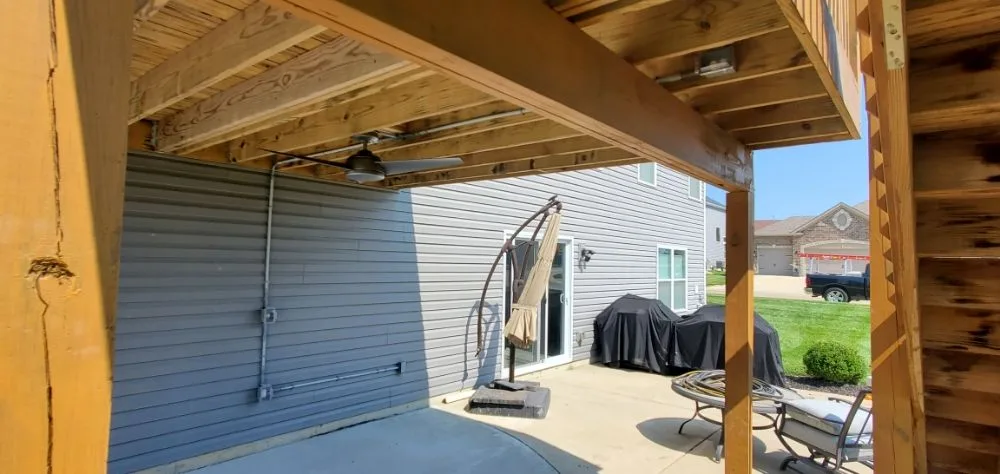
Most of the failures are at the connections, not the fixtures: wire nuts buried in the mulch, undersized runs that dim at the far end, transformers sized to today’s fixture count with nothing left over.
So the connections are listed for direct burial, the runs are sized for voltage drop at the far fixture, and the transformer has headroom for the next few additions.
What the price actually depends on
Three things move the number on almost every job: how far the run has to travel and what it passes through, whether the existing panel has space and the service has capacity, and whether the municipality wants a permit and an inspection. None of those is visible from the phone call, which is why the measurement comes before the quote.
What does not move it is urgency theatre. There is no inflated figure waiting to be discounted, and no bundle built so the thing you called about cannot be bought on its own.
What makes this harder in older housing stock
Across this metro the recurring complications are predictable: no equipment ground, aluminum branch wiring from the mid-seventies, knob-and-tube buried in blown-in insulation, panels that have been added to several times, and splices in places the code has not allowed for decades.
Those turn a simple job into a decision about scope. The decision gets put to you with the reading behind it rather than made quietly and billed.
“Clint came out installed me a large 200 amp panel put some new dedicated lines in my basement and garage he did great clean work all inspections passed he was thorough and knowledgeable. I will have him back out again.”
Jason Holtzman · Google review
How the visit goes
- The call
Which room, what is wrong with it now, and how the room is used in the evening.
- The measurement
Ceiling height, joist direction and position, existing switch legs, and what the circuit already carries.
- The finding
A layout with spacing that works, a switching plan, and a dimmer matched to the fixtures you have chosen.
- The work
Boxes set where the fixtures need them, remodel housings cut in from below on finished ceilings, dimming tested on every circuit before the ladder comes down.
What the job includes
- Layout set from ceiling height and beam angle before any hole is cut
- Boxes placed where the fixture needs them
- Dimmers matched to the drivers so nothing flickers
- Switch legs planned around how the room is used
- Fixtures installed, aimed and tested
- Old fixtures removed and the openings made good
What it does not
- Supplying decorative fixtures, unless you ask
- Painting after a ceiling patch
- Drapery and blind hardware
If the fix belongs to another trade, you get the name of one rather than a price from this one. See the work itself, or send the details.
Related lighting work
Landscape Lighting across the metro
The same job is not the same job in every part of this metro. Out of O’Fallon across thirty municipalities, where the permit process changes more than the work does.
St. Louis City
The City is an independent city, not part of the County, and it runs its own permits and inspections. Assuming county process here is a common and expensive mistake.
Lincoln County
Well and septic loads mean a failure is no water rather than an inconvenience, so those circuits get treated accordingly.
Warren County
Two kinds of work share the same ZIP codes here: recent subdivisions with modern wiring and tight services, and farm properties carrying several eras at once.
The whole working radius is mapped on the service areas page.
Questions worth asking first.
Can recessed lights go in a finished ceiling?
Usually yes, with remodel-rated housings cut in from below. Joist position decides spacing, which is why the layout gets set before any hole is cut.
How many recessed lights does a room need?
Spacing comes off the ceiling height, and joist direction decides where a housing can physically sit. The layout gets drawn before anything is cut rather than counted off a rule of thumb.
Can you match colour temperature to my existing fixtures?
Yes, and it matters more than people expect. Mixed temperatures in one room read as a mistake even when every fixture works.
Where do you work?
Out of O’Fallon across St. Charles County, St. Louis County, St. Louis City, and Lincoln and Warren counties, roughly a fifty mile radius.
Do you pull permits?
Where the municipality requires one, yes, and the work is left ready for inspection with the panel labeled and junctions accessible. Requirements genuinely differ across this metro, which is why it is established per address rather than assumed.
Talk to the person who will do the work.
No dispatcher, no salesman. Clint takes the call and Clint does the job. Landscape Lighting in O’Fallon and across the metro.
Weekdays 8-5, Fri to 4, Sat 10-3 · or describe it in writing.